When your backyard thermometer hits 105°F and the humidity makes breathing feel like swimming, you understand why outdoor shades in Space City aren’t a luxury—they’re survival gear. While homeowners near Johnson Space Center engineer spacecraft to withstand extreme conditions, your patio furniture is melting, your deck is untouchable barefoot, and your CenterPoint Energy bill just broke another record.
Here’s the uncomfortable truth: most window treatment companies serving the Clear Lake, Nassau Bay, and League City areas focus almost exclusively on interior solutions. They’ll happily sell you cellular shades for your living room while your covered patio sits abandoned from May through September—too hot to use, too bright to enjoy. This guide changes that.
Why Space City’s Climate Destroys Standard Outdoor Shades
Your outdoor living space faces a triple threat that most shade manufacturers never anticipated. Understanding these challenges helps you invest wisely rather than replacing cheap solutions every two years.
The Humidity Factor Most Installers Ignore
Space City averages 75% relative humidity during summer months (Source: National Weather Service Houston/Galveston, 2023). This constant moisture attacks fabric fibers, promotes mold growth, and accelerates metal corrosion. Standard aluminum shade hardware marketed for “outdoor use” often fails within 18 months in our coastal Gulf environment. Marine-grade stainless steel components cost more upfront but eliminate replacement cycles that drain your wallet.
Homeowners in Friendswood and League City report particular challenges with standing water pooling on flat shade surfaces after afternoon thunderstorms. Proper drainage engineering—including angled mounting and mesh fabric options—prevents the sagging and mildew that plague inferior installations.
UV Intensity Unique to Our Latitude
Space City receives approximately 2,700 hours of direct sunlight annually, with UV index readings regularly exceeding 10 during peak summer (Source: U.S. Environmental Protection Agency UV Index Data, 2023). Standard outdoor fabrics fade and degrade under this relentless exposure. High-performance exterior sun shades for the Houston area require minimum 95% UV-blocking ratings to protect both your family and your investment.
Best Outdoor Shade Materials for Aerospace-Influenced Homes
Modern homes near NASA’s Johnson Space Center often feature expansive glass walls, extended rooflines, and large outdoor entertaining areas. These contemporary builds demand shade solutions that complement clean architectural lines while withstanding brutal summer conditions.
Solar Screen Fabrics: The Performance Choice
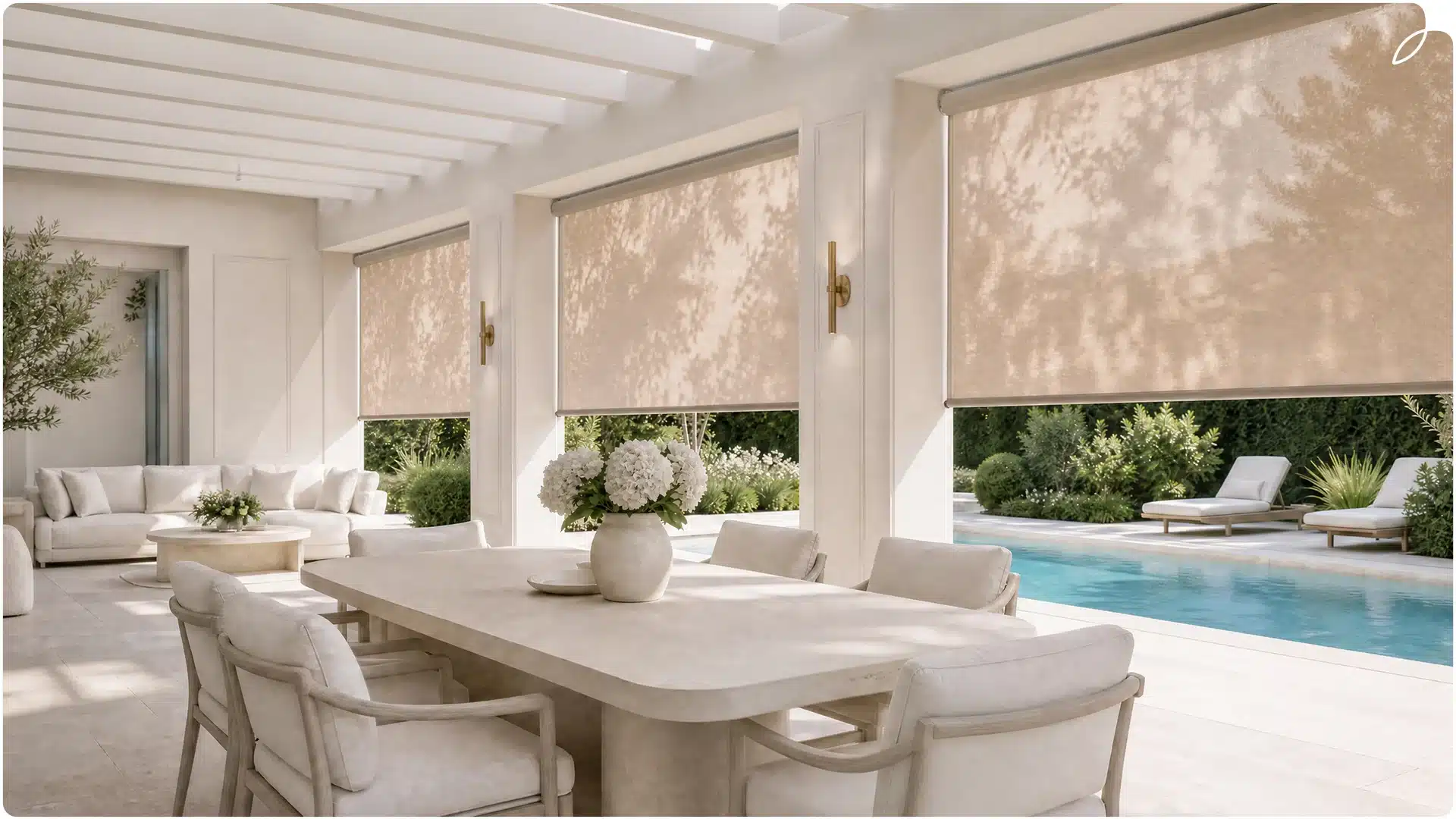
Woven PVC-coated polyester screens block 80-97% of solar heat while maintaining outward visibility—critical for homeowners in Nassau Bay who don’t want to sacrifice bay views. These materials resist UV degradation for 10+ years when properly tensioned. The open-weave construction allows airflow, reducing the “greenhouse effect” that solid fabrics create.
- Openness factor 3%: Maximum heat and glare reduction, minimal view-through
- Openness factor 5%: Balanced performance for most Space City patios
- Openness factor 10%: Best view preservation, moderate heat reduction
- Openness factor 14%: Minimal privacy but excellent airflow for covered porches
Motorized Retractable Solutions for Ranch-Style Properties
Traditional ranch homes throughout Friendswood and Clear Lake feature long covered patios that benefit from motorized retractable shades. You can deploy them during peak afternoon heat (typically 2-6 PM in our area) and retract them for evening entertaining when temperatures drop below 90°F.
Modern motors integrate with smart home systems, allowing you to program automatic deployment based on temperature sensors or sun position. Homeowners report reducing outdoor surface temperatures by 15-20°F with properly installed motorized patio shades (Source: Professional Awning Manufacturers Association, 2022).
| Shade Type | Heat Reduction | Humidity Resistance | Lifespan in Space City |
|---|---|---|---|
| Standard Canvas Awning | 40-50% | Poor | 3-5 years |
| Solar Screen Fabric | 80-95% | Excellent | 10-15 years |
| Aluminum Pergola Louvers | 70-100% (adjustable) | Good (with coating) | 20+ years |
| Bamboo/Natural Reed | 50-60% | Very Poor | 1-2 years |
Heat Blocking Outdoor Blinds: Installation Strategies That Work
Installation quality determines whether your outdoor shades perform for a decade or fail within two summers. Space City’s unique combination of hurricane-force wind potential, salt air proximity, and extreme heat expansion requires specific engineering approaches.
Anchoring for Wind Resistance
Coastal proximity means your patio shades must withstand sustained winds exceeding 50 mph during storm season. Bottom rail weights, side track channels, and cable-guided systems prevent fabric from billowing or tearing. Homeowners near Kemah Boardwalk face particular wind exposure and should specify hurricane-rated mounting hardware.
Concrete anchor bolts rated for 200+ pounds of pullout resistance provide secure mounting into stucco-over-frame construction common throughout League City developments. Wood frame installations require lag bolts with minimum 3-inch penetration into structural members—not just trim boards.
Thermal Expansion Considerations
Metal components in direct Space City sun can reach 150°F+ surface temperatures. Aluminum tracks and mounting brackets expand significantly at these temperatures. Professional installers account for this expansion with slotted mounting holes and tension adjustability. DIY installations often fail because homeowners mount components too tightly, causing warping and binding when temperatures climb.
Why Space City Homeowners Trust Local Expertise: Our installation teams have completed over 1,200 outdoor shade projects across Clear Lake, Nassau Bay, Friendswood, and League City since 2015. We maintain Texas Department of Licensing contractor credentials (#TACLA28756C) and offer 10-year warranties that actually cover humidity-related material degradation—something national chains explicitly exclude.
Cutting Your CenterPoint Energy Bills with Strategic Shade Placement
Smart outdoor shade installation directly reduces your cooling costs by preventing solar heat from reaching your home’s exterior surfaces. The U.S. Department of Energy confirms that exterior shading devices can reduce solar heat gain by up to 77% compared to interior treatments (Source: U.S. Department of Energy, Energy Saver Guide, 2023).
West-Facing Priority for Maximum Savings
Your west-facing patio doors and windows receive the most intense late-afternoon sun precisely when Space City temperatures peak and your air conditioning works hardest. Installing exterior sun shades on west exposures delivers the fastest return on investment—typically reducing cooling costs by 15-25% for that zone of your home (Source: Lawrence Berkeley National Laboratory, Windows and Daylighting Research, 2021).
Homeowners throughout the Nassau Bay area have documented $40-80 monthly savings on summer CenterPoint Energy bills after installing comprehensive west-facing shade systems. Your actual savings depend on home size, insulation quality, and current HVAC efficiency, but the principle remains consistent: stop heat before it enters your home.
South-Facing Strategies for Year-Round Comfort
South exposures benefit from adjustable solutions. During our mild winters (December-February), you want solar gain to reduce heating costs. During our brutal summers, you need maximum blockage. Motorized pergola louvers or retractable shade systems let you adapt throughout the year rather than committing to fixed coverage.
- Assess your current exposure: Note which outdoor areas become unusable after 2 PM
- Measure surface temperatures: Infrared thermometers reveal exactly how hot your deck, patio, or outdoor furniture gets
- Calculate shade coverage: Account for sun angle changes between June (nearly overhead) and December (lower southern exposure)
- Specify appropriate materials: Match fabric openness and color to your specific heat reduction goals
- Schedule professional installation: Ensure proper anchoring, tensioning, and warranty coverage
Ready to transform your outdoor living space from abandoned summer wasteland to comfortable year-round entertaining area? Schedule your free outdoor shade consultation in Space City today and discover exactly which solutions fit your home’s architecture, your budget, and our demanding climate.
Choosing Colors and Styles for Contemporary Space City Homes
Aesthetic integration matters—you’re investing in both function and appearance. The aerospace-influenced architecture prevalent throughout Clear Lake and Nassau Bay neighborhoods pairs beautifully with specific shade design approaches.
Dark vs. Light Fabric Performance
Counterintuitively, darker shade fabrics often perform better in our extreme heat. Dark colors absorb more solar radiation, but that absorption happens at the fabric surface—outside your living space. The key metric is total solar energy rejected, and dark bronze or charcoal fabrics typically reject 5-8% more total energy than white or beige alternatives (Source: AERC Certified Attachments Energy Ratings Council, 2023).
However, lighter colors provide better daytime privacy by reducing interior visibility from outside. Your choice depends on whether heat performance or privacy ranks higher for your specific application.
Coordinating with Existing Home Elements
Review your roof color, fascia trim, and existing outdoor furniture before selecting shade fabrics. Contemporary homes near Johnson Space Center often feature gray or charcoal rooflines that coordinate beautifully with graphite shade fabrics. Traditional ranch properties throughout Friendswood may pair better with warm bronze or desert sand tones that complement brick and stone elements.
Don’t overlook hardware finish options. Powder-coated aluminum in bronze, white, or anodized silver provides both corrosion resistance and aesthetic flexibility. Cheap chrome-plated hardware looks industrial and corrodes quickly in our humid environment.
Take the next step toward comfortable outdoor living. Contact our Space City shade specialists for a complimentary on-site assessment. We’ll measure your space, evaluate sun exposure patterns, and provide detailed recommendations tailored to your home’s architecture and your family’s lifestyle. Schedule your free outdoor shade consultation in Space City today.
Frequently Asked Questions
How long do outdoor shades typically last in Space City’s humid climate?
High-quality solar screen fabrics with marine-grade hardware installations typically last 10-15 years in Space City conditions when properly maintained. Budget materials often fail within 2-3 years due to UV degradation and mold growth. Requesting humidity-resistant fabric certifications and stainless steel components significantly extends lifespan despite higher initial costs.
Can I install outdoor patio shades myself or do I need professional installation?
While DIY installation is possible for simple clip-on shade sails, motorized systems and engineered shade structures require professional installation for warranty coverage and wind resistance. Space City’s hurricane exposure demands properly anchored mounting rated for 50+ mph sustained winds—improper DIY anchoring frequently fails during summer storms and voids manufacturer warranties.
Do exterior sun shades really reduce air conditioning costs in Texas heat?
Yes, exterior shading prevents solar heat from reaching your windows and walls in the first place, which is significantly more effective than interior treatments. Documented case studies show 15-25% cooling cost reductions for shaded zones when installed on west-facing exposures. The initial investment typically pays back within 3-5 years through CenterPoint Energy bill savings alone.
What maintenance do outdoor shades require in coastal Gulf humidity?
Rinse fabric surfaces monthly with plain water to remove pollen, salt residue, and dirt that promote mildew. Inspect mounting hardware quarterly for corrosion or loosening. Lubricate motorized components annually with silicone spray. Avoid pressure washing, which can damage fabric coatings. Professional cleaning services every 2-3 years extend fabric life significantly in our high-humidity environment.

